A Reader’s Pause for a Developing Story
A developing-story reading routine helps you track what changed, identify the update that matters, and avoid spending time on refreshes that add nothing.
When a local alert says a bridge is closed, the next question is often practical: Is it still closed, and what changed since the alert? A developing-story reading routine helps you answer by tracking the story’s updates and their sources, rather than repeatedly rereading the same page.
Keep the focus on a specific question, such as whether a road has reopened or whether an official briefing has added information. A short note in your phone’s Notes app can show which update addressed that question and which did not.
Choose a useful question
Before returning to a story, write down what you need to know. A narrow question gives each update a purpose; “What is happening?” is difficult to answer, while “Has the transit agency announced a service change?” points you toward a relevant statement.
Separate the answer from the account that supplies it. An article may quote a transit agency, describe a reporter’s observation, or link to a public notice. Those are different sources, and identifying them helps you understand what kind of information the update adds.
Track the update
Record the outlet, the time you read the page, and the one claim that bears on your question. If the article names a source for that claim, include the source too. This small record makes it easier to compare versions without trying to reconstruct a page from memory.
- If the page names an official source for a service change, record the agency and the statement; if it does not, note that the source is not identified and look for the linked notice or another account.
- If an update note explains what was added, write down that change; if no note appears, compare only the passage relevant to your question and avoid assuming why the page changed.
- If a live blog adds a new entry, note its time and subject; if the entry does not address your question, skip it rather than rereading the full feed.
- If the story links to a public document, open it and check whether it addresses the same issue; if the document is unavailable or unrelated, rely on the article’s attribution and record that limitation.
- If two outlets attribute conflicting statements to different sources, record both attributions; if the accounts concern different times or locations, keep them separate rather than treating them as a direct conflict.
- If a correction changes a detail central to your question, update your note and reconsider your answer; if it changes an unrelated detail, preserve the correction without treating it as a change to the point you are tracking.
Separate source roles
A source’s role affects what its statement can tell you. An agency may provide an operational update; a witness may describe what they saw from one location; an expert may explain a process without having direct knowledge of the event. Attribution gives readers a way to assess the basis of a claim, but a source’s statement should not be stretched beyond its scope.
For example, “the fire department said crews had left the building” is a report about what the department stated. It does not by itself explain the cause of the fire. Keep those questions distinct, and look for the story to identify who is addressing each one.
What should you check next?
Should I follow a live blog or a standard article?
A live blog can be useful when the sequence of announcements matters, while a standard article may gather the main account in one place. Choose the format that answers your question, and check whether its entries or update notes identify sources.
What if the page has no update note?
Compare the specific passage you care about with your earlier note, if you have one. If you cannot tell what changed, treat the difference as unclear and look for an explicit correction, linked statement, or new attribution.
How should I handle conflicting accounts?
Write down the exact point of disagreement and who supports each account. Check whether the statements refer to the same time and place; if they do and the story does not resolve the difference, leave it unresolved.
When should I stop checking?
Stop when new updates no longer address your question or when the relevant source has issued the information you needed. Return if a later announcement changes that specific point, rather than refreshing out of habit.
Work through one update
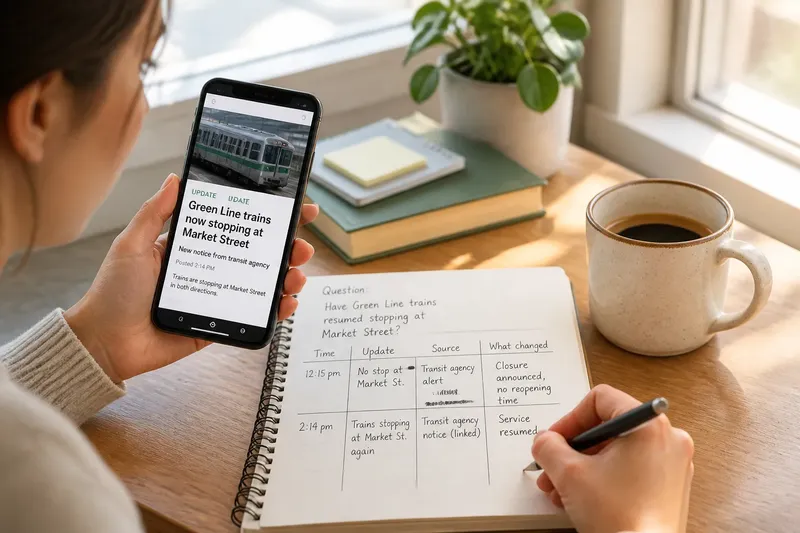
Imagine you read a hypothetical transit alert at lunchtime. It says the Green Line is not stopping at Market Street, attributes the notice to the transit agency, and gives no reopening time. Your question is whether trains have resumed stopping there.
You write: “Green Line; Market Street; no stop; agency notice; reopening time not stated.” Later, a hypothetical update says trains are stopping at Market Street again and links to a new agency notice. You check that the station and line match, add the new statement and its source, and answer your question: service has resumed according to the linked notice. The earlier closure remains part of the sequence, but it no longer answers the present-status question.
Keep the record focused
For a developing news story, a useful note is not a transcript. Keep the link, the question, the source named for the relevant claim, and what the update changed. If the next visit adds no information about that question, leave the note as it is and spend your attention elsewhere.
This routine is about following how a particular account develops, not deciding every issue the story raises. A clear record of the source and the update lets you see what the reporting addressed, what it did not address, and whether another visit is likely to help.